 [Work in progress]
The proliferation of visual content surrounding our daily lives has led to a pervasive emphasis on the manipulation of images. The media that disseminate these images encourage us to select, collect, and organize them, as well as to retouch and alter them. The proliferation of digital images thus appears as a phenomenon that goes hand in hand with the growing role of curator and editor. This role, once reserved for a few experts, can now also be supported by artificial intelligence (AI), that lists, organizes, and even generates visual data. But have curating and editing truly become essential tools in visual studies and museum practice? What is their exact place in the processes of perception and understanding images, whether in a scientific or cultural context? For the former, can we speak of an epistemology of image gestures, at a time when their manipulation is so profoundly influenced by digital technology? For the latter, is there an ethic of curation that is activated in response to images, when it comes to museum mediation?
This cross-disciplinary approach, integrating visual knowledge, digital devices, and encounters with artworks in museums, has been the focal point of the research project titled “Augmented Artwork Analysis – Computer-aided device for art images” (AAA, 2021-2025, supported by the French Agence Nationale de la Recherche and the Luxembourg National Research Fund). The “Curating & Editing – Between Museums and Media” conference aims to share its findings and explore further developments, centered on the crucial question of the gestures of image-based knowledge.
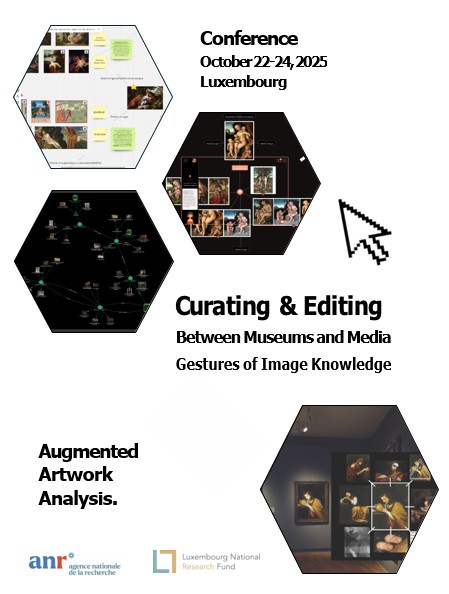
 Above, three types of work on and with images, which represent key stages of the AAA project: (1) Diagrammatic study of a painting, (2) Encoding and structuring of data, (3) Design of its tablet application.
The image serves as our starting point. As we are aware, the way an image fits into a collection, its place in an exhibition, its hanging, and its position within a wall of images are all factors that modulate and intensify its perception. This principle has accompanied the museum’s very inception. It will be called curating, while avant-garde, essayistic and, above all, cinematographic experiments have developed collage, montage and editing (as defined by the Hollywood film industry), with the aim of refining the meaning of images through other images, rather than through words. If the modernity of visual media enables a true training for the eye, what remains of this in contemporary scientific and cultural practices?
Today, the museum seems to have lost its central mission of educating the public about images – a purpose that originally motivated its creation. However, could it not play a role in teaching curation and montage by integrating ad hoc digital tools? This would mean finding a middle path between the traditional, “paternalistic” approach (“The artwork is this”), and the contemporary, “populist” approach (“The artwork is whatever you make of it”). This balance is crucial to foster a dynamic that moves beyond established knowledge, without falling into purely spontaneous perception or unlimited idiosyncrasy. On the one hand, we should no longer simply be informed about the image, but learn to work with it. On the other hand, the focus would shift from immediate appropriation to knowledge gained through multiple mediations. This approach entails a careful examination of the image itself, augmented by its interconnections with other images, through various arrangements and displacements, with or without AI assistance. The method is therefore characterized by a series of attempts and unexpected outcomes, which implies a very particular attention to one’s own making-process.
But how do the disciplines of the visual arts (art history, semiotics, philosophy, anthropology, etc.) engage with images to go beyond mere recognition of established knowledge or mere recording of its empirical applications? To what extent is science, which aims to better see images, prepared to explore its own gestures for analyzing images, to seek alternative forms of teachings derived from its active experimental practices? Finally, how can it envision, or even improve, its own tools and media?
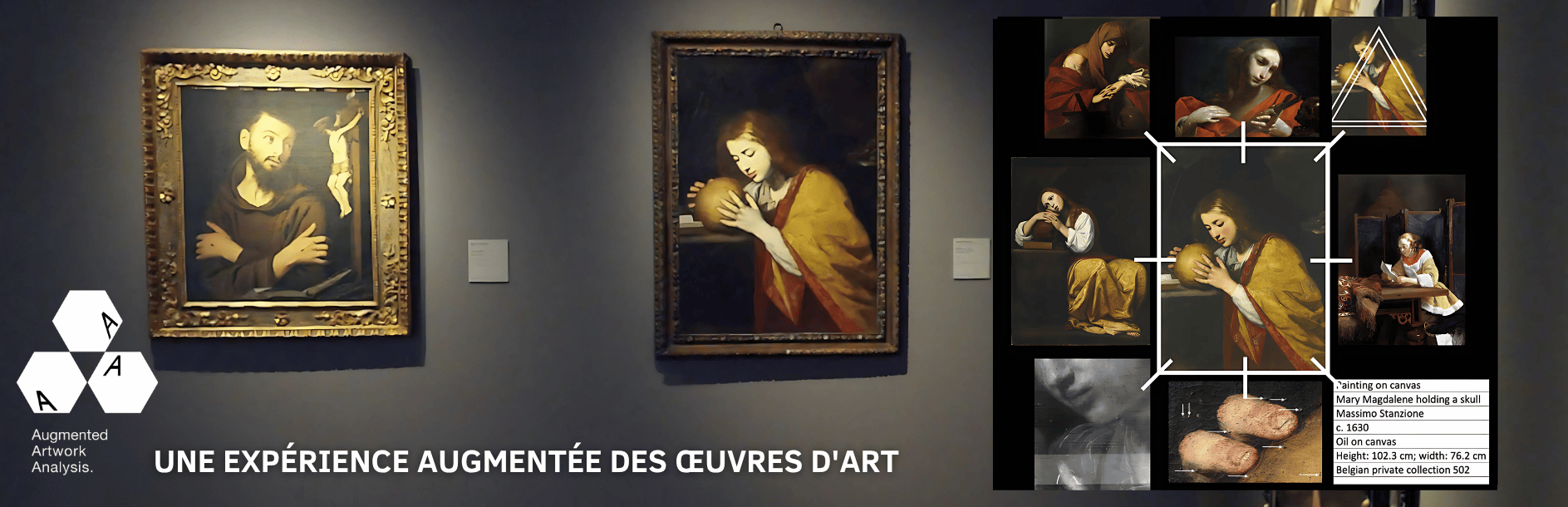
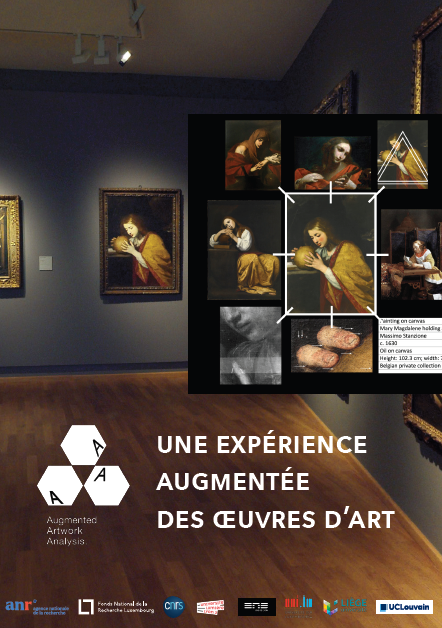
The objective of the conference is to address the aforementioned inquiries, which have also underpinned the prototype application planned by AAA: a media tool designed to build knowledge of paintings encountered in museums. It does so by dissecting the artwork on screen and, above all, by re-editing and re-exhibiting it alongside other images. The interface offers an active montage of images, creating a complementary digital museum that incorporates AI. This tool, used in a museum context, prompts users to compare the original work with its digital replica, and the images surrounding it. While digital, this mediation facilitates a more profound comprehension of the materiality of the artwork: its techniques, its medium, its restorations and alterations – in short, its life through time. A dialectic thus emerges between the encounter and the gestures, in other words, between looking at the work exhibited in an augmented way and working on it as a manipulable image, with the aim of deepening our knowledge. Eventually, the AAA interface seeks to offer a true laboratory for curating and editing, both for the expert, who can never have enough experience, and for the visitor, who can always visit better.
Organisation
Gian Maria Tore (gian-maria.tore@uni.lu) et Roxanne Loos (roxanne.loos@uclouvain.be) with
Pierluigi Basso Fossali (University of Bologne) Mathias Blanc (University of Luxembourg) Ralph Dekoninck (University of Louvain)
Ruud Priem (Musée national d’archéologie, d’histoire et d’art du Luxembourg) Gilles Zeimet (Centre National de l’Audiovisuel du Luxembourg)
Dates and venues
October 22 at Musée national d’archéologie, d’histoire et d’art (MNAHA), Luxembourg October 23 at Centre National de l’Audiovisuel (CNA), Luxembourg: Dudelange October 24 at University of Luxembourg: Belval campus, Maison des sciences humaines