
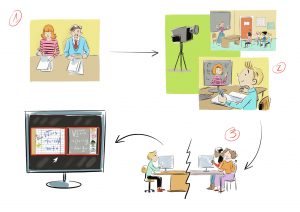
This Research Project focuses on Marginalia, in particular Visual Marginalia (VM). They are a common phenomenon in school, but they hold untapped potential. We aim to understand their nature and role in learning and thinking. Marginalia are generally described as making annotations in book margins. We extend this concept to include visual self-expressions such as para-writings and para-drawings, creative drawings and writings at the margin of books or notebooks, modifications of book pictures, titles or texts, squiggling and doodling. VM are part of students’ self-regulatory processes and are not requested by the teacher. In this project, we will first describe our emerging methodology to grasp the phenomenon of VM. Secondly, we will use the wall of screens (i-Screen-M) to analyze complex data collected with different methods: questionnaires, video-recorded lessons, observations of the lessons, auto-confrontation interviews (in which the interviewer shares two screens with the interviewee: the first contains the student’s marginalia and the second contains the lesson).
The main objectives of the project Visual Marginalia and Co-elaboration of Knowledge inside groups using i-Screen-M are:
- to assess our proposed methodology;
- to collect additional data on VM,
- no other author has studied VM with primary and middle school students in an ecological educational environment;
- to observe the cognitive-affective function of VM in order to understand the extent to which they are self-regulatory, co-regulatory, and socially shared regulatory practices in the specific classroom contexts;
- to theoretically reposition and develop the first descriptive model on Visual Marginalia elaborated after the first collection of data;
- to practice collaborative data analysis of VM within the DatAgora Project and document how multi-screen, multi-user, collective spaces with multi-directional sound facilitates researchers’ team work.